In the landscape of modern businesses, one essential element stands out as the driving force of organizational success: human capital. In businesses' competition to get ahead of one another, the effective management of human capital is highly important; this is where talent management comes into action. In this article, we examine a comprehensive road map, including eleven essential stages, for designing a talent-management strategy:
What does talent management mean?
Talent management is beyond mere HR processes. It is a strategic approach to attracting, developing, and retaining top talent to achieve organizational goals, and it includes a range of interrelated processes aimed at maximizing people's potential while aligning their capabilities with the organization's needs.
At the depth of its meaning, talent management revolves around the attention to the fact that employees are not just resources, but valuable assets that are vital to organizational success. This requires cultivating a culture that values talent, values continuous growth, and creates an environment in which people can progress and contribute meaningfully.
Start from strategy
Start by aligning the talent-management goals with the organization's broader strategic goals. Specify the skills, competencies, and leadership traits needed for success in the organization's current and future landscape.
Conduct a complete assessment of the talent needs at all levels of the organization. Determine the vital roles, skill gaps, and areas in which a talent shortage may hinder progress.
Designing a talent-management strategy requires a careful combination of foresight, agility, and a deep understanding of organizational needs. Here, we examine 11 key stages:
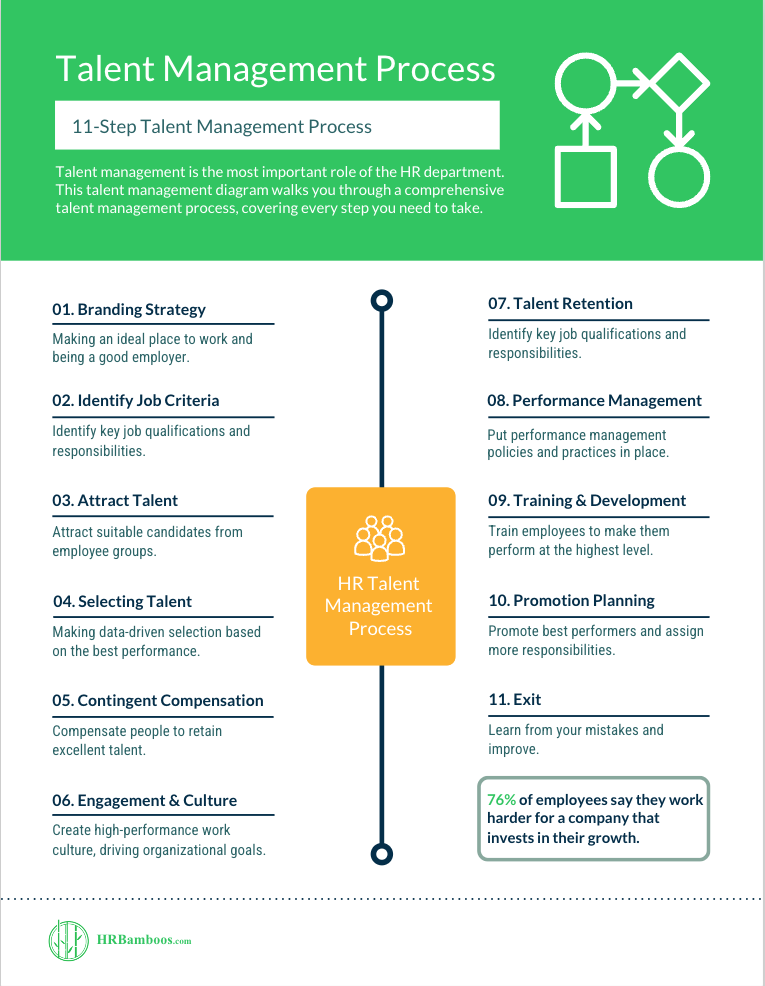
1. Employer-brand strategy
Creating a credible employer brand is the first step in attracting top talent. Define your organization's values, culture, and distinguishing traits to distinguish your identity in the market and attract candidates who are interested in your brand!
2. Specify the job criteria
Define clear job criteria and competency frameworks suited to each role in the organization. Specify the skills, qualifications, and traits needed for success in each position to ensure alignment with the organizational goals.
3. Attracting talent
Use your branding strategy to attract top talent through various recruitment channels. Active talent-sourcing, using social-media platforms, and creating relationships with industry networks are good options for expanding the talent pool.
4. Selecting talent
Design precise, strong attraction and hiring processes to identify the best candidates. Believe it or not, the quality of your attraction process is the most important factor in talent's decision to collaborate with your organization. To assess candidates' knowledge, skills, and cultural fit, conduct comprehensive, complete assessments and examinations.
5. Attractive salary and benefits
To attract top talent, create distinctive, more flexible compensation packages. Offer a combination of rewards, benefits, and monetary incentives suited to individual preferences and performance.
6. Participation in culture
Institutionalize a culture of participation and inclusion to cultivate a positive work environment. Promote open communication, recognize achievements, and provide opportunities for employees to help the organization's culture grow with ideas and feedback.
7. Retaining talent
To retain top talent and reduce the departure rate, you need particular strategies. Provide opportunities for career and individual development, offer continuous support and guidance, and appreciate employees' achievements to increase employee satisfaction and loyalty.
8. Performance management
A transparent performance-management system plays an important role in setting clear expectations, providing regular feedback, and aligning individual goals with organizational goals. Assess performance objectively and, based on it, recognize and reward high-performing people.
9. Training and development
To enhance skills, knowledge, and competencies, invest in employee training and development programs. Provide opportunities for continuous learning, coaching, and career advancement to empower employees to reach their full potential.
10. Growth and promotion planning
For key job positions, have growth and promotion planning. By identifying and cultivating potential talent, prepare them for these positions. Provide clear paths for career advancement that require a lot of effort, seriousness, and learning, and cultivate a culture of internal mobility.
11. Exit
Manage employees' exit with professionalism and empathy. Conduct exit interviews to collect feedback, identify areas for improvement, and ensure a smooth transition for departing employees.
In conclusion, talent management is not a one-time effort, but a continuous journey that requires careful planning, execution, and adaptation. By following the eleven-stage road map stated in this article, organizations can build a strong talent-management strategy that enables them to attract, develop, retain, and grow top talent and build sustainable growth and success in today's dynamic business environment.
Stay tuned and follow us on our social media!